
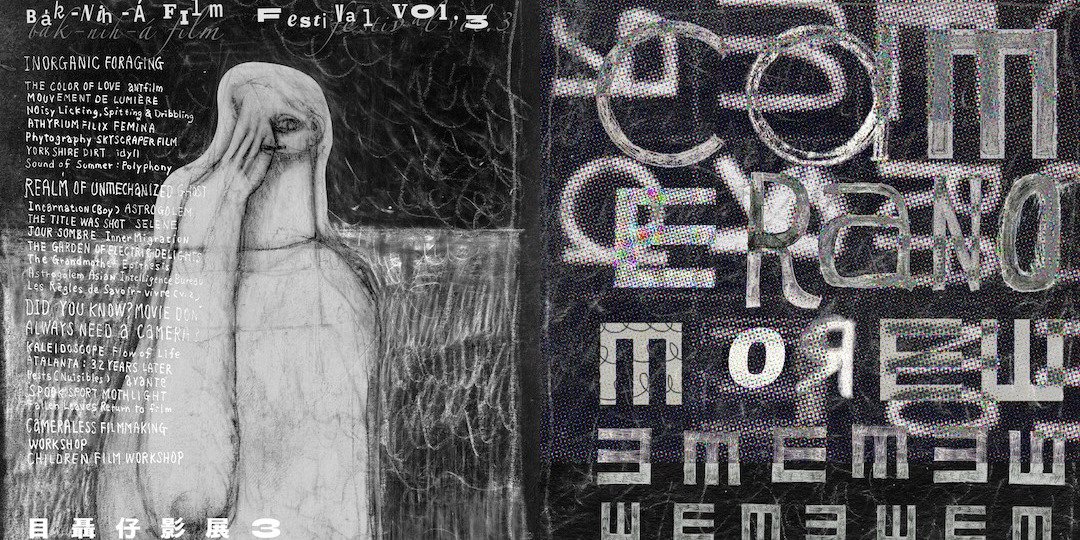

無機幽靈之境 Realm of Cameraless Phantoms
當影像不再依賴攝影機的拍攝,而是在既有材料、數位系統與演算過程中生成,一種介於實體與虛體之間的影像狀態隨之浮現。本單元聚焦於這些「無機」影像的多重生成方式:從底片與檔案影像的再加工,到電玩引擎、類比訊號與人工智慧所生成的視覺形式,呈現影像如何在不同媒介之間被轉譯、召喚與重組,如同幽靈般徘迴於來源與再現之間。
在類比與檔案影像的轉化中,《定格一擊》拼接1920至1980年代的電影片段,使類型角色跨越時代錯置共演;於家庭電影膠卷上加工的《陰鬱之日》,讓私人記憶發展出潛伏的平行敘事;《(男孩)轉世》則透過正負像並置,使身體、自然與幻象相互滲透,召喚出影像的另一種生命;《亞洲情報局》則以歷史新聞片與AI生成聲音交錯,使影像與聲音逐漸錯位,提問當兩者不再屬於同一身體時,歷史如何被感知與記憶。《星際巨靈》結合故障藝術與低解析影像,構築一則關於人造生命的科學寓言;利用回授影像技術的《電力樂園》建構出由類比訊號構成的流動場域。最後,《衿光é流儀》以現場表演延續對影像材料的直接操作,混合16mm、Super 8、手工膠卷與幻燈片等異質素材。影像將在類比與數位之間被切割、疊合與干擾,聲音亦同步生成與錯位。邀請觀眾經驗一場在放映機與訊號之間展開的即時重組,使影像成為持續變動的感知場域。
在這些作品中,影像不再穩定地指向現實,而是在不同技術條件中持續被轉換與再生。「無機幽靈」因此不僅是風格或意象,而是一種狀態:影像作為殘影、訊號與資料,在媒介之間反覆顯影,既可被操作,也始終帶著無法完全掌握的距離。
When images no longer rely on camera capture, but emerge from existing materials, digital systems, and algorithmic processes, a state between the physical and the virtual arises. This program explores the diverse generative modes of these “cameraless" images—from reworked film stock and archival footage to visuals produced by game engines, analog signals, and AI—revealing how images are translated, summoned, and recombined across media, lingering like phantoms between origin and representation.
Through analog and archival transformations, The Title Was Shot splices clips from the 1920s to the 1980s into an anachronistic co-performance of genre tropes. Reworked directly on home movie stock, Jour Sombre unlocks a latent parallel narrative within private memories, while Incarnation (Boy) juxtaposes positive and negative imagery so that body, nature, and illusion interpenetrate, invoking another life for the image. Asian Intelligence Bureau interweaves historical newsreels with AI-generated voiceovers, gradually dislocating sound from image to ask how history is perceived when the two no longer share the same body. Meanwhile, Astrogolem blends glitch art and low-resolution visuals into a scientific fable on artificial life, and The Garden Of Electric Delights uses video feedback to build a fluid field of analog signals. Finally, the live performance Les Règles de Savoir-vivre (v.2) extends direct material manipulation by mixing 16mm, Super 8, handmade film, and slides—slicing, layering, and interfering with images and sounds between analog and digital realms to turn projection into an ever-shifting field of perception.
In these works, the image no longer points stably to reality, but is continuously transformed across technological conditions. "Cameraless Phantoms" is thus not merely a style, but a state: images as afterimages, signals, and data, repeatedly developing across media—manipulable, yet always retaining an ungraspable distance.
目聶映像文化/Bak-Nih Audiovisual Lab