

【國際紀工來串門|Doc From Afar】
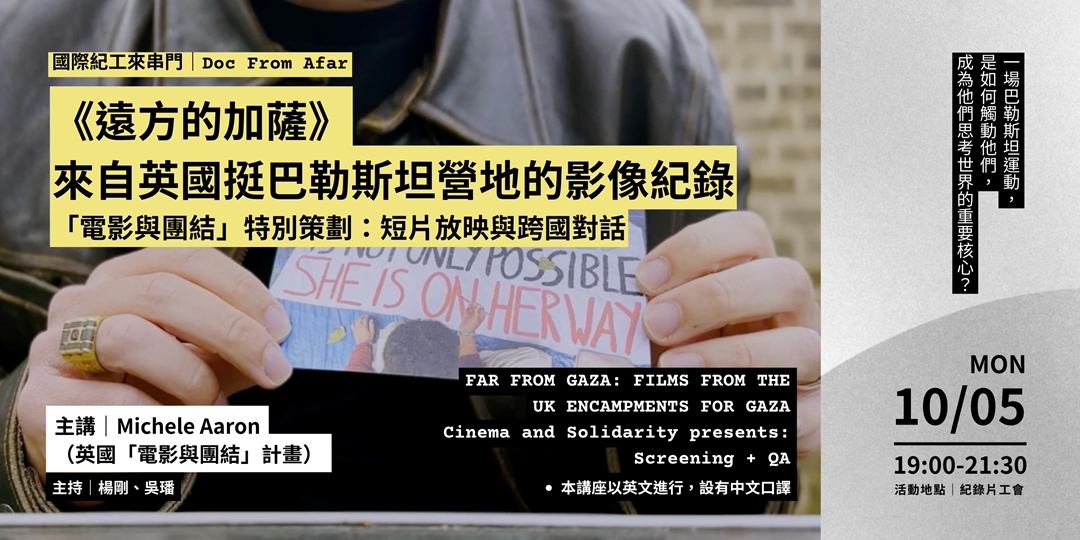
🍉《遠方的加薩》:來自英國挺巴勒斯坦營地的影像紀錄 🍉
「電影與團結」特別策劃:短片放映與跨國對話
踏入10月,加薩種族滅絕正式進入第三個年頭,我們邀請到了英國「電影與團結」計畫來分享巴勒斯坦團結電影。這部合輯作品收錄了劍橋大學聲援巴勒斯坦紮營佔領行動中學運參與者拍攝的四部短片,以及英國各地紮營運動者的訪談,探討了共同抵抗的議題——特別是巴勒斯坦或猶太裔背景學生的參與。是怎樣的經歷與觀點,促使他們投身這場政治運動,並持續反對一場在加薩遠方的種族滅絕?一場巴勒斯坦運動,是如何觸動他們,成為他們思考世界的重要核心?這部電影為社會運動與跨文化團結提供了深刻的洞察,展現了這些運動者們在前線時的勇氣與多元思考。
放映結束後,制片人Michele Aaron將會現身映後座談。
*電影配備中文字幕,活動以英文進行,設有中文翻譯
日期:2026年10月5日
時間:19:00–21:30
地點:台北市紀錄片從業人員職業工會(台北市大同區興城街10巷16號2樓)
主講:Michele Aaron(英國「電影與團結」計畫)
主持:楊剛、吳璠
關於「電影與團結」
電影與團結"計劃旨在通過電影探索巴勒斯坦人、猶太人及多元文化間的共同抵抗。
加薩遠方:英國校園聲援巴勒斯坦紮營佔領運動短片合輯
FAR FROM GAZA: FILMS FROM THE UK ENCAMPMENTS FOR GAZA
Manal Massalha、匿名學生行動者 | 英國 | 2025年 | 60分鐘
本作品是在「電影與團結」研究計劃下制作完成。該計劃由華威大學(University of Warwick)資助,並由電影與電視研究系Michele Aaron主持。
四號短片 Short no. 4 (2025)
當「猶太至上主義」意識形態正主宰者對巴勒斯坦人的種族滅絕,決定在聲援巴勒斯坦紮營佔領行動中以猶太人身份組織行動,到底意味著什麼?本片記錄了紮營行動結束後一年裏我們彼此的反思,試圖捕捉以猶太人身份投入到聲援巴勒斯坦此一決定中的張力、兩難與困境。分享這些未解的、棘手的、緊張的反思,是為了提醒及預防行動未來受到猶太至上主義癱瘓及限制的可能。我們必須在高度情緒化及充滿爭議的政治論述中,保持這種清晰的認知,繼續走下去。
九月之歌 September Song (2025)
在聲援巴勒斯坦紮營佔領行動中的第一周,一位埃及朋友問我:「這裡有讓你想起塔利爾廣場嗎?」塔利爾廣場是埃及革命的爆發地,掀起了中東地區的民主化浪潮「阿拉伯之春」,而巴勒斯坦議題則在這場革命中佔據了核心地位。看著眼前的人群,我回答道:「確實如此……也許是國王大道(King's Parade)上一個縮小版的塔利爾廣場。」
我與朋友心照不宣的是:這個類比中有一抹暗黑。我們心裏都清楚,政變後的政權已重塑了那個廣場:曾經的革命地圍了起來、方尖碑高聳入雲、一座來自盧克索斯的芬克斯像被被遷移至此充當守衛。
如今的埃及,已然是種族滅絕的共犯。我無意帶著偽裝成懷舊的的幻滅去重返那場革命,也無意以那樣的眼光看待劍橋的紮營行動。然而,兩者都是屬於這樣的時刻:眾人與我在歷史中做出了澄明的選擇,時間彷彿暫停、歷史即將轉折的時刻。
《九月之歌》(Ghenwa Septemberiyya)是薩拉赫·賈欣(Salah Jaheen)所寫的一首詩,由蘇阿德·侯斯尼(Soad Hosni)在去世前不久於倫敦錄制。詩中的情感與我產生了共鳴:詩人懇求放映機暫停膠卷,好讓人們得以仔細端詳。起初,我以為巴勒斯坦的解放會源自塔利爾廣場。而現在,我卻開始思考,或許方向恰恰相反。
分界線 The Dividing Line (2025)
導演:Oliver Dixon、Katie Wrench
音效:Jo Haynes
聲援巴勒斯坦紮營佔領行動該如何被記憶?從一幅空蕩的草坪畫面中,我們如何(不)能夠把握什麼?
回溯性的衝動之所以危險,是它或許會滑向造神式的歌頌。我們所進行的是一場既針對自身、又針對他者的鬥爭,但卻在急於將紮營行動塑造成「抵抗典範形象」的過程中被遺忘。如果說電影能為在地的種族滅絕反抗中做些什麼,那不應是使這些鬥爭被固化、被制成標本。長期以來,有關運動的討論,多著眼於如何處理緊迫而持續的政治情勢問題,我們則希望將再現(representation)的議題,同樣置於議程的核心。巴勒斯坦終將自由。
回望 Looking Back (2025)
兩幅畫面始終縈繞在我腦海中:一個是雙臂交叉、別過臉去的漢達拉(Handala)形象,另一個則是哈馬斯領導人葉海亞·辛瓦爾(Yahya Sinwar)在生命最後時刻,直視以色列國防軍無人機、宣告自己死亡的那張廣為流傳的照片。這兩幅標志性畫面讓我久久難以釋懷的,是抵抗行動與這兩種身姿的關係。一個是「別過臉去」,一個是「回望」,在聲援巴勒斯坦紮營佔領行動中,我們究竟是在回望大學及其所施加的暴力,還是在別過臉去,以團結之姿望向加沙?特別是當世界呼籲「目光聚焦拉法」(All eyes on Rafah)——儘管這對他們並沒有帶來多少實質幫助——這種望向的姿態又意味著什麼?
主辦單位:臺北市紀錄片從業人員職業工會 及 台灣巴勒斯坦自由連線
【Doc From Afar】FAR FROM GAZA: FILMS FROM THE UK ENCAMPMENTS FOR GAZA
Cinema and Solidarity presents: Screening + QA
Join us to watch and discuss a series of short films made by student-activists from the Gaza encampments in the UK!
This compilation of films was produced within the Cinema and Solidarity research project,
funded by the University of Warwick and led by Michele Aaron of Film and Television
Studies. It contains the four short films made by student activists at the University of
Cambridge encampment as well as interviews made with student activists from there and
encampments elsewhere in the UK. The films explore co-resistance, particularly by students of Palestinian or Jewish heritage. These diverse and brave works offer unique insight into activism and cross-cultural solidarity. They reflect the students’ rich experiences and perspectives which drew them to the political movement opposing the ongoing genocide.
The screening will be followed by a panel discussion and audience Q&A with the producer Michele Aaron.
*Bilingual Event
Date: 5 October 2026
Time: 1900-2130
Venue: Taipei Documentary Filmmakers' Union
Address: 2F, No.16,Ln. 10, Xingcheng St., Datong Dist., Taipei City
Host: Yang Kang, Wu Fan
Guest: Michele Aaron, Cinema and Solidarity
About Cinema and Solidarity
The aim of the Cinema and Solidarity project was to explore Palestinian, Jewish and multi-
cultural co-resistance through film.
FAR FROM GAZA: FILMS FROM THE UK ENCAMPMENTS FOR GAZA
Anonymous student activists, Manal Massalha | United Kingdom | 2025 | 60 min
DIRECTORS’ NOTES:
Short no. 4 (2025)
What did it mean to decide to organise as Jews within an encampment opposing a Jewish
supremacist genocide of Palestinians? In recording a conversation of reflections shared often between us in the year since the encampment, we have attempted to capture a small document of the tensions, dilemmas, and difficulties of the decision to engage our Jewishness in the work of solidarity. We hope that sharing something of the unresolved, the tricky and the tense in our conversations registers the importance of maintaining this clarity amidst highly emotive, contested political discourses that, wrongly approached, can demobilise and constrain our action.
A September Song (2025)
On the first weekend in the encampment, an Egyptian friend asked me, ‘doesn’t this remind you of Tahrir?’ Palestine had been central to the Egyptian revolution. Looking at the crowd, I replied, ‘it does… maybe a miniature version of Tahrir on King’s Parade’.
The connection to Tahrir carries a darker note. My friend’s comment was not entirely
optimistic—we both knew it. The coup regime has remade the square, erecting a majestic
obelisk, moving ram-headed sphinxes from Luxor to act as guards enclosing what were once
revolutionary grounds. Egypt is now complicit in genocide. I do not revisit the revolution
with disillusionment disguised as nostalgia, nor do I look at the Cambridge encampment in
that way. I regard both as moments when I, alongside many, made what felt like the right
choice—moments when it felt like time paused before history shifted gears.
Ghenwa Septemberiyya (A September Song), a poem written by Salah Jaheen and
recorded by Soad Hosni in London shortly before her death, echoed this sentiment when I
first joined the project. The poem asks the projector to pause the reel so we can take a
closer look. At first, I thought the Palestinian liberation would come from Tahrir. Now, I
wonder if it might be the other way around.
The Dividing Line (2025)
Directed by Oliver Dixon and Katie Wrench
Sound by Jo Haynes
In our film we wanted to scrutinise the problem of memorialising the encampments. We asked: what can and cannot be grasped from the emptiness of this image?
We felt that this retrospective compulsion could become dangerously hagiographic. That ours was a struggle against ourselves and for another might be lost in the rush to make
the encampments the image of resistance par excellence. If cinema can do anything for the domestic struggle against the genocide, it is not to actualise further struggles or mummify old ones. Rather, we hope that it can pose the problems of representation as central to how we approach urgent and ongoing political imperatives. Free Palestine.
Looking Back (2025)
Two images kept coming to mind: the figure of Handala looking away with his arms
crossed, and the final much shared image of Hamas leader Yahya Sinwar looking straight at
the IDF drone announcing his death. What stayed with me in relation to these two iconic
images was the relationship between resistance and the acts of looking away or looking
back. And from this, I wondered, what is it that we were doing in that encampment, what
happened? Were we looking back at the university and the violence it perpetrates or looking
away from it, in solidarity, towards Gaza: “All eyes on Rafah” (for all the good it did them)?
Organiser: Taipei Documentary Filmmakers' Union and Taiwan Alliance for a Free Palestine