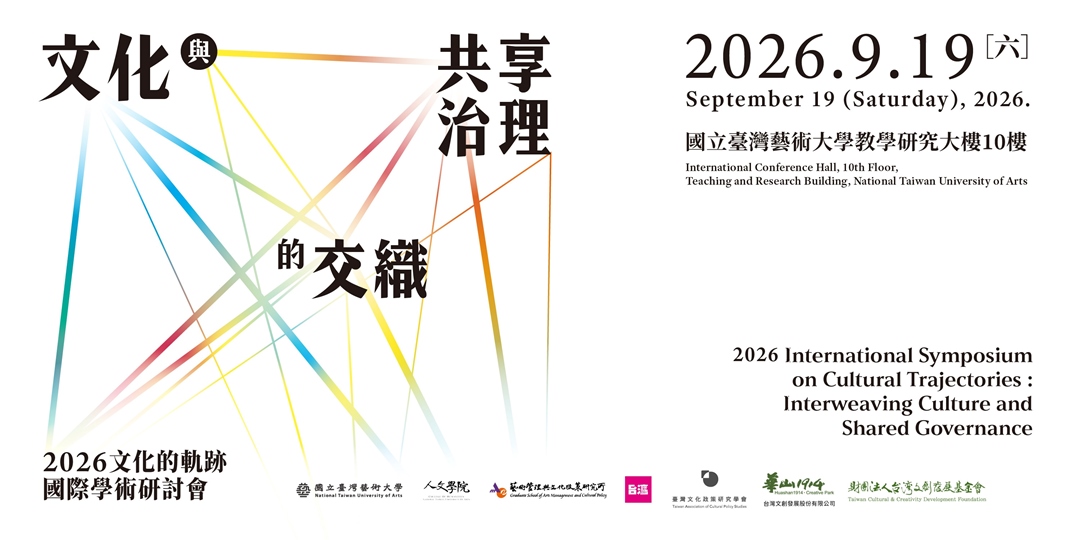

2026 文化的軌跡:文化與共享治理的交織 國際學術研討會
2026 International Symposium on Cultural Trajectories: Interweaving Culture and Shared Governance
年度主題介紹
「文化的軌跡」國際學術研討會自2008年開辦迄今,已連續辦理二十屆。近3年來以「2025文化的軌跡:文化MBTI」、「2024文化的軌跡–文化價值的辯證:對話與實踐」與「2023文化的軌跡:藝術.管理.人工.智慧」為主題,敏銳關注不同藝文趨勢發展,致力搭建文化學術研究與實務工作的溝通平台,也思索國內外藝術管理與文化政策治理的多元取徑。
今年主題為「文化與共享治理的交織」,立意援引「文化生態系」作為一種研究的思路觀點,提醒我們看待藝文生態,或可理解為一個由不同參與角色、不同組織機構等所共同構築的網絡關係,藉由穿梭彼此的能動作用,也形成「互為主體」的依存對應。而「共享治理(shared governance)」是指一種調和與平衡不同行動者可及參與的過程,內涵應超越片面權力與掌控資源之分配,本次研討會希望彰顯,文化與共享治理在藝文生態脈動中,所能扮演積極、殊異與引領性的角色價值。
我們深入探問,如何將可支配的權力資源、包括所期待或所獲得的價值利益,體現在多方行動者之間以達到共享治理?當涉及公、私部門與中介組織協力運作來導控、調節有關政治、社會與經濟爭議問題時,如何橋接官僚理性與公共參與的鴻溝,促使鼓勵更具創意之夥伴形式,幫助克服政府與市場同時失靈的可能窘境?又或如何更加開放給生態網絡中參與角色的行動投入,從而實踐分歧社會的各種價值調和,提增相互影響與共融願景?綜合上述,呼應文化生態系動態交織的視角,延伸接合「數位、空間、群體、個體」豐厚層面的論述形構與實踐敘事。
本屆盼從研究案例中尋找以文化為主體,開展共享治理的借鏡,廣泛連結官僚機構、市場機制、民間組織、社區自治及學術智庫等有機能量,反映透過參與、互助、賦權、合夥乃至抵抗等不同行動的聚合成果,論證生態網絡中相互依存之肯認意義,同步也詮釋藝術工作者、藝文團體、政府機構、民間產業、中介組織及學術單位等,如何「現在進行式」地一起刻劃這條文化途徑。爰此,「2026文化的軌跡:文化與共享治理的交織」國際學術研討會,徵求以下子題論文,期待激盪出更多理論與實踐的交會啟發,也讓以文化為核心的共享治理,更加在臺灣盛開綻放。
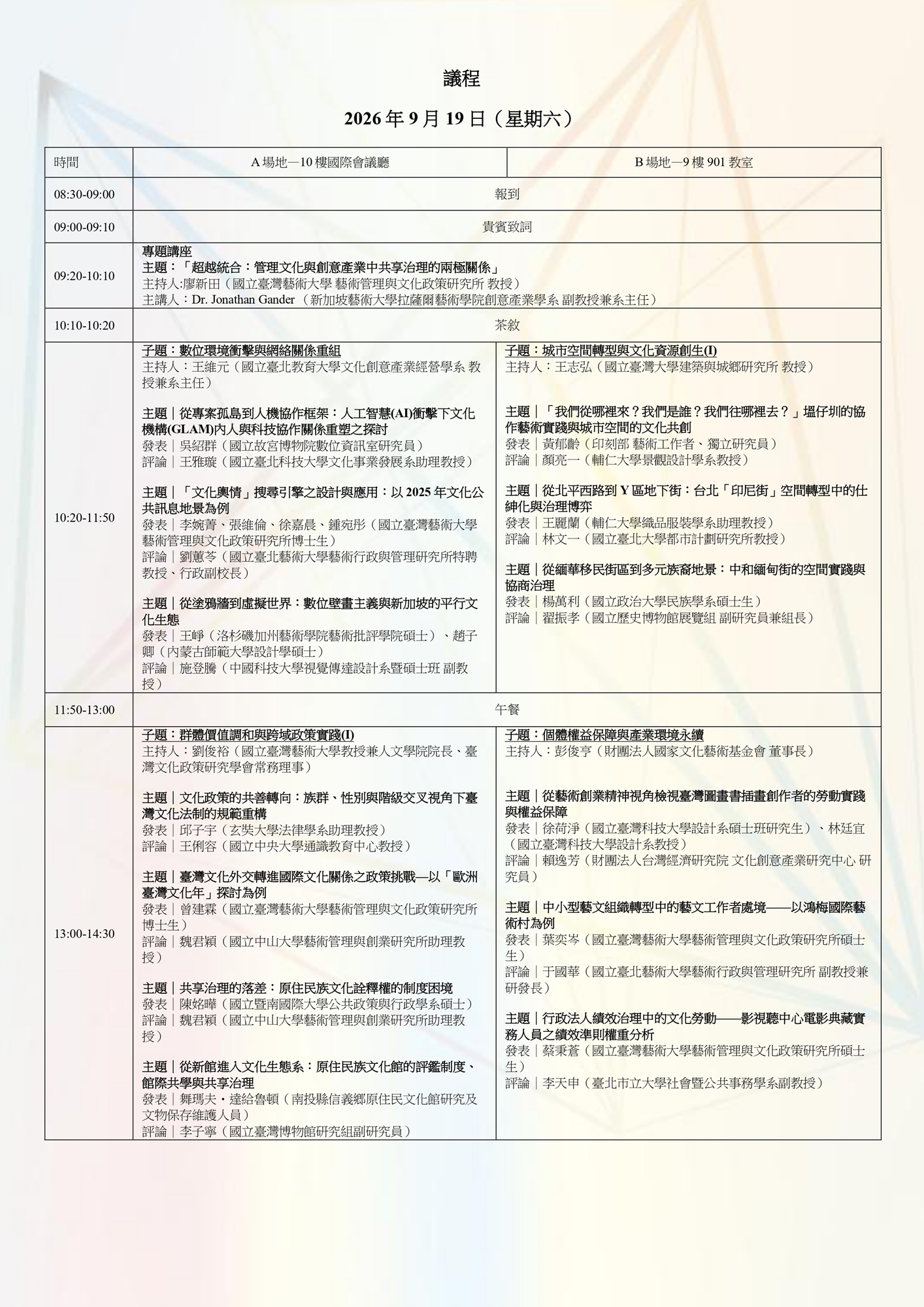
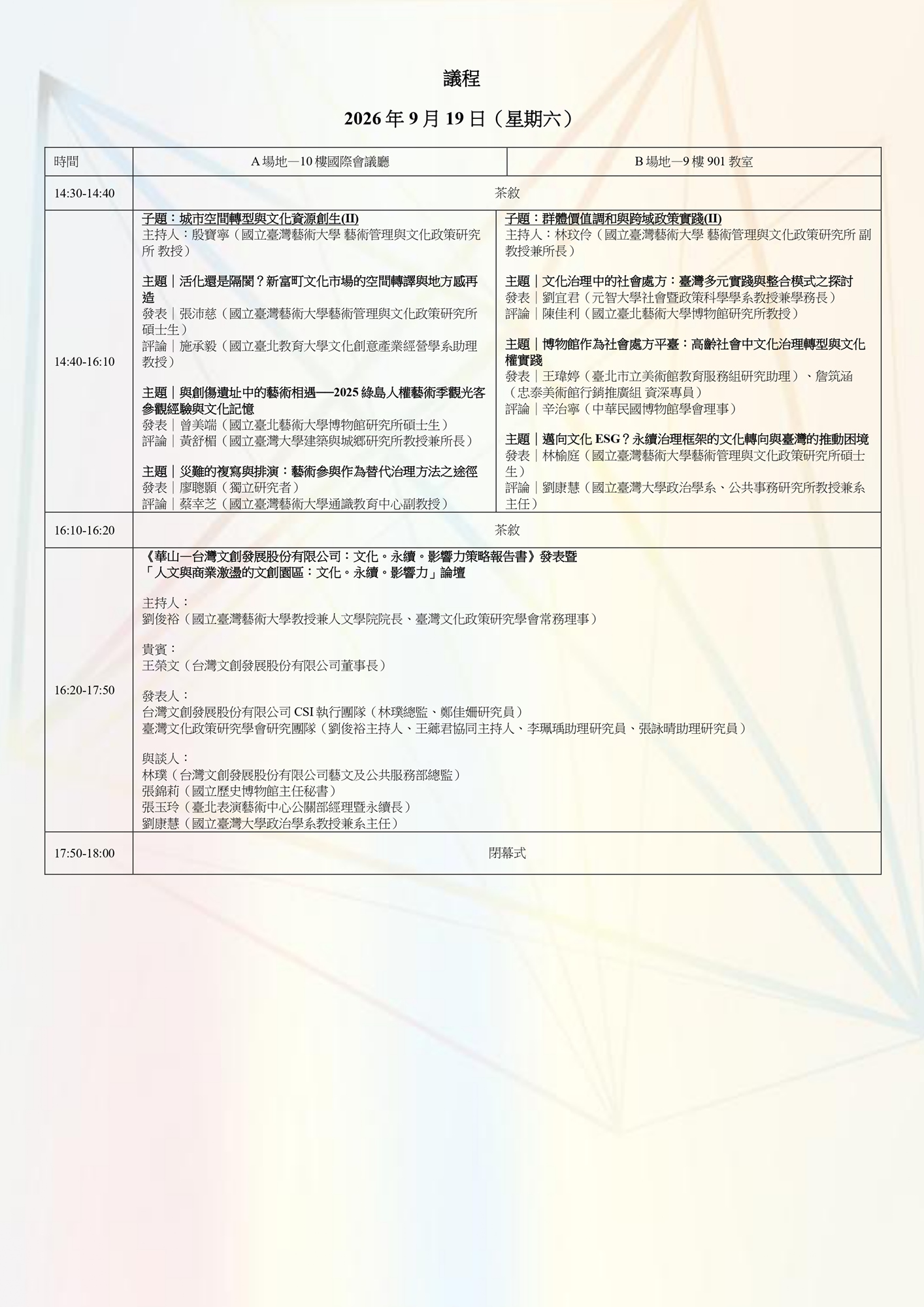 謹註:主辦單位保留議程彈性調整權力,最後版本以現場公告為準;本次研討會為公益免費性質,為留存會議紀錄,凡報名參與者,即視為同意授權主辦單位於活動期間進行攝影、錄影,並得將相關影像成果用於本活動之紀錄、成果發表與非營利推廣。主辦單位承諾,上述影像資料僅限於本案相關用途,未經台端同意,絕不另作他用,以維護您的權益。
Introduction to the Annual Theme
The "Cultural Trajectories" International Symposium has been held for 20 consecutive sessions since 2008. Over the past three years, with themes such as 2025 "Cultural MBTI: Culture as an Entangled Ecosystem," 2024 "Dialectics of Cultural Values: Dialogue and Practice," and 2023 "Arts|Management|Artificial|Intelligence," the symposium has keenly observed various trends in the arts and cultural sectors, dedicating itself to building a communication platform between academic research and practical work, while exploring diverse perspectives to arts management and cultural policy governance both domestically and internationally.
The theme of 2026 would be "Interweaving Culture and Shared Governance." This theme draws upon the "cultural ecosystem" as a research perspective, in which arts and cultural ecology can be understood as a network constructed jointly by different actors. Through their dynamic interactions with one another, a relationship of interdependence and intersubjectivity is formed. "Shared governance" refers to the process of harmonizing and balancing the accessible participation of different actors, the connotations of which should transcend the unilateral exercise of power and the control over resource distribution. Therefore, this symposium hopes to highlight the proactive, distinctive, and leading values that culture and shared governance can play within the pulse of the arts and cultural ecosystem.
We deeply inquire, how can the power and resources available for distribution, including anticipated or acquired values and interests, be manifested among multiple actors to achieve shared governance? When public sectors, private sectors, and intermediary organizations collaborate to guide and regulate controversial political, social, and economic issues, how can the gap between bureaucratic rationality and public participation be bridged? How can we encourage more creative forms of partnership to help overcome the potential dilemmas of simultaneous government and market failures? How can we open up further to the active involvement of participants within the ecological network, thereby practicing the harmonization of diverse values in a divided society and enhancing mutual influence and a vision of inclusivity? Synthesizing the above, and echoing the dynamic interweaving perspective of the cultural ecosystem, this theme extends to articulate discourses and practical narratives across the rich dimensions of the "Digital”, “Spatial”, “Collective”, and “Individual”.
This year’s symposium aims to draw lessons from research cases that position culture as the primary subject in developing shared governance, broadly connecting the organic energies of bureaucracies, market mechanisms, civil organizations, community autonomy, and academic think tanks. We aim to reflect on the aggregated outcomes of different actions—such as participation, reciprocity, empowerment, partnership, and even resistance—demonstrating the recognized significance of interdependence within the ecological network. Simultaneously, we seek to interpret how arts workers, cultural groups, government agencies, private industries, intermediary organizations, and academic institutions are collectively carving out this cultural trajectory. Therefore, the "2026 International Symposium on Cultural Trajectories: Interweaving Culture and Shared Governance" invites paper submissions on the following sub-themes, anticipating the sparking of further inspiration at the intersection of theory and practice, and allowing shared governance centered on culture to bloom even more vibrantly in Taiwan.
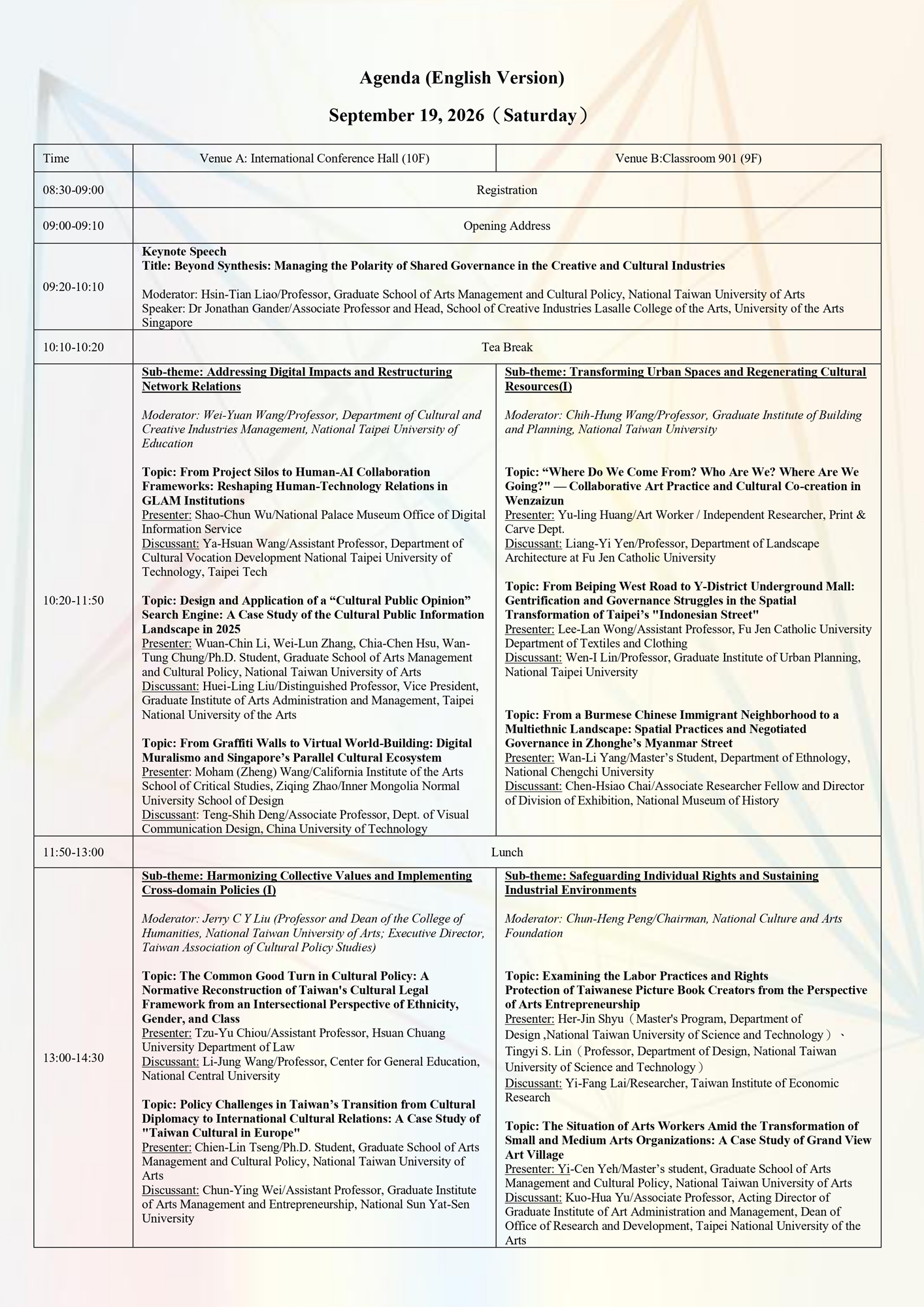
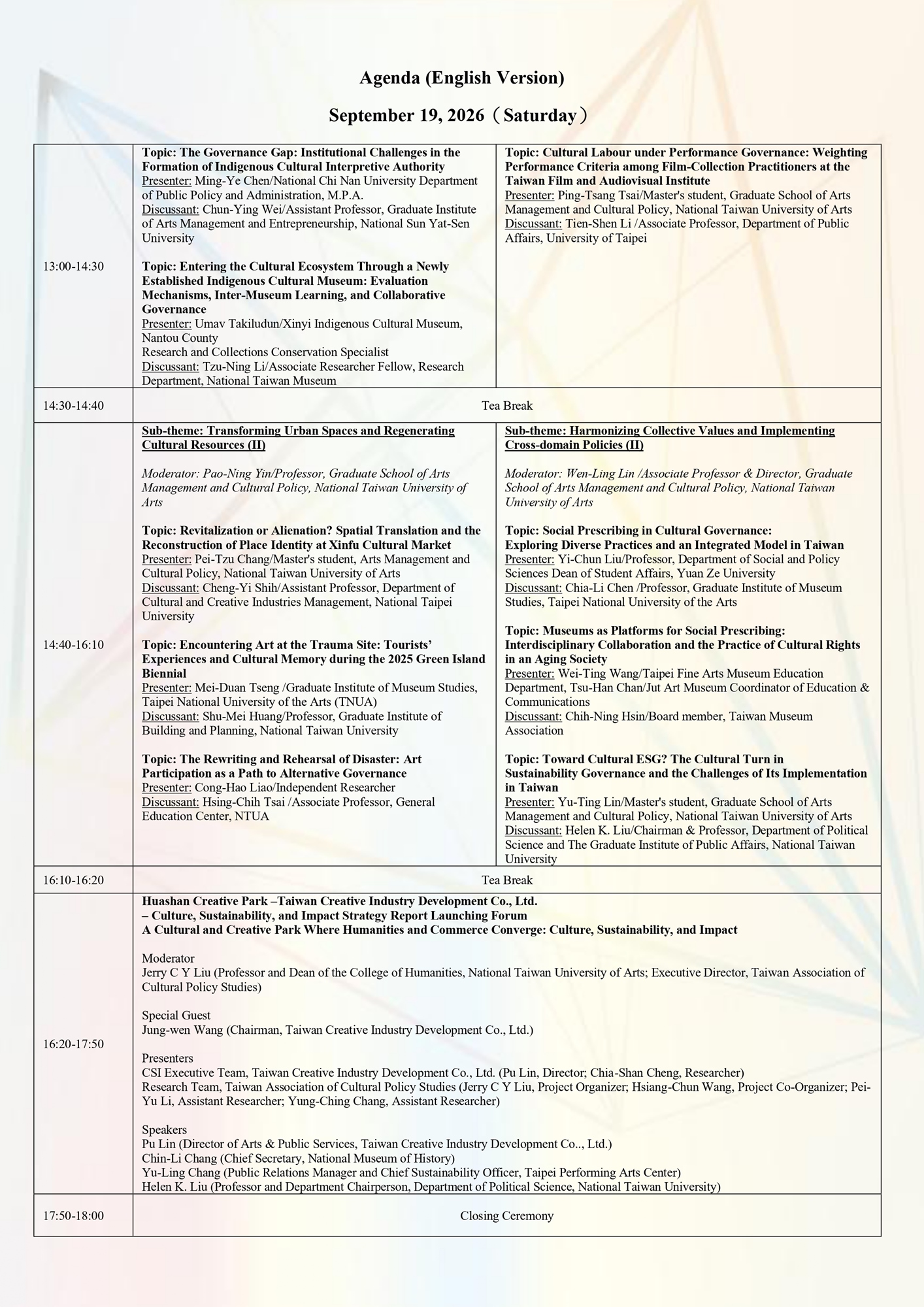 Note: The organizer reserves the right to modify the agenda; the final version will be announced on-site.
As this symposium is a non-profit, free event, all registered participants are deemed to agree to authorize the organizer to conduct photography and video recording during the event for official records. The resulting media may be used for event documentation, outcome publications, and non-profit promotion. The organizer commits that such media materials will be used strictly for purposes related to this event and will not be used for any other purpose without your prior consent, thereby safeguarding your rights and interests.
---------------------------------------------------------------------------------------
主辦單位:國立臺灣藝術大學人文學院藝術管理與文化政策研究所
合辦單位:台灣藝術史研究學會、臺灣文化政策研究學會、華山1914台灣文創股份發展有限公司、財團法人台灣文創發展基金會
會議日期:2026年9月19日(六)
會議地點:國立臺灣藝術大學教研大樓10樓國際會議廳、9樓901教室
Organizer: Graduate School of Arts Management and Cultural Policy, College of Humanities, National Taiwan University of Arts
Co-organizers: Taiwan Art History Association, Taiwan Association of Cultural Policy Studies, Huashan 1914 Taiwan Cultural-Creative Development Co., Taiwan Cultural & Creativity Development Foundation
Dates: September 19 (Saturday), 2026.
Venue: International Conference Hall, 10th Floor, Teaching and Research Building, National Taiwan University of Arts