
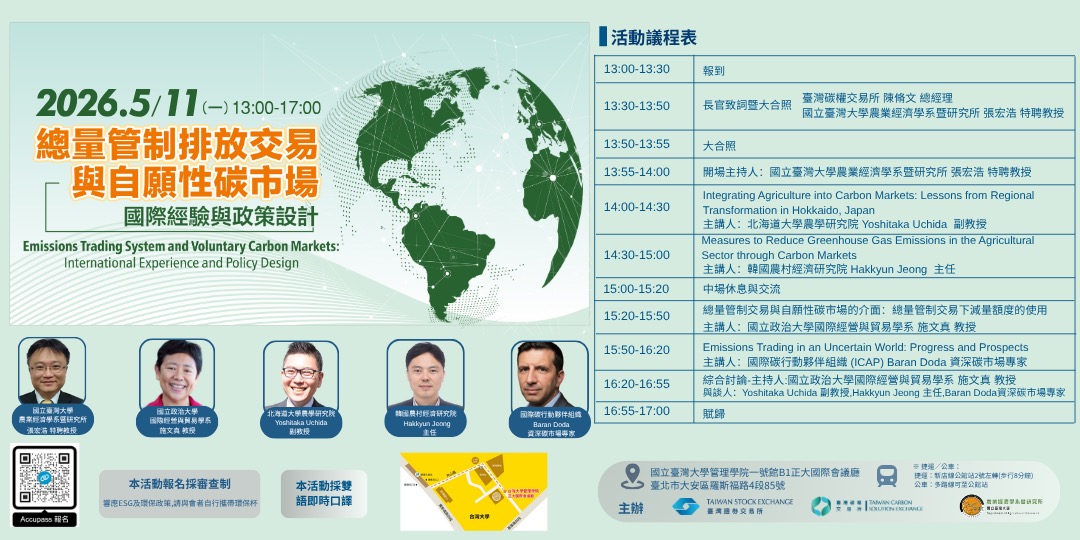
在全球淨零轉型加速推進之際,碳定價機制已逐步成為各國氣候治理與產業轉型的重要政策工具。其中,總量管制排放交易制度(Cap-and-Trade)透過設定排放上限與配額交易,引導企業以具成本效益的方式達成減量;而自願性碳市場(Voluntary Carbon Markets)則透過碳權專案與減量額度,為企業提供補充性的減碳路徑與投融資誘因。兩者如何分工、互補,乃至於如何避免重複計算、維持市場公信力與環境完整性,已成為國際政策設計的核心議題。
As the global transition toward net zero continues to accelerate, carbon pricing has become a central policy instrument for climate governance and industrial transformation. Among these approaches, cap-and-trade systems guide emitters toward cost-effective reductions by setting emissions caps and enabling allowance trading, while voluntary carbon markets provide complementary decarbonization pathways and financing incentives through carbon credit projects and offsets. How these two markets should interact, complement one another, and avoid problems such as double counting while preserving market credibility and environmental integrity has become a key issue in international policy design.
本次論壇以「總量管制排放交易與自願性碳市場:國際經驗與政策設計」為題,聚焦國際制度演進、農業部門參與碳市場的實務經驗,以及總量管制制度與自願性碳市場之間的制度介面。活動將邀集來自日本、韓國、國際碳行動夥伴組織(ICAP)及臺灣之專家學者,從政策、制度、產業與區域治理等面向進行交流,協助與會者掌握全球碳市場最新脈動與未來發展方向。
This forum, titled “Emissions Trading System and Voluntary Carbon Markets: International Experience and Policy Design”focuses on the evolution of international carbon market systems, practical experiences in integrating the agricultural sector into carbon markets, and the institutional interface between cap-and-trade mechanisms and voluntary carbon markets. Bringing together experts and scholars from Japan, Korea, the International Carbon Action Partnership (ICAP), and Taiwan, the event will offer multidimensional insights into policy, regulation, industry practice, and regional governance, helping participants better understand current developments and future directions in global carbon markets.
在議程安排上,場次一將以日本北海道地區的轉型經驗為案例,探討農業如何逐步納入碳市場體系,並進一步介紹碳市場在農業部門溫室氣體減量中的應用與措施。場次二則延伸至國際排放交易制度的整體進程、在不確定政治經濟環境下的挑戰與前景,以及總量管制交易制度中如何運用減量額度、如何界定與自願性碳市場的功能邊界等重要政策問題。
In terms of program design, Session I will begin with the case of regional transformation in Hokkaido, Japan, examining how agriculture can be incorporated into carbon market systems, followed by a discussion of offset projects in the agricultural sector under the Korean Measures to Reduce Greenhouse Gas Emissions in the Agricultural Sector through Carbon Markets. Session II will broaden the discussion to the overall development of emissions trading systems, the challenges and prospects of carbon markets in an uncertain geopolitical and economic environment, and critical policy questions such as the use of offsets in cap-and-trade schemes and the proper delineation of boundaries between compliance and voluntary markets.
本活動除專題演講外,亦安排綜合討論與交流時段,期望透過跨國比較與專家對話,深化各界對碳市場治理、農業減量方法學、碳權品質管理及政策協調機制之理解。對於政府部門、研究機構、企業永續與碳管理人員,以及關注氣候政策與綠色金融發展之人士而言,本次論壇不僅是一場知識交流平台,更是一個觀察國際趨勢、連結政策與市場實務的重要窗口。可以說,碳市場看似在談配額與額度,實際上談的是治理能力、制度信任與轉型競爭力;若制度設計得好,碳權不只是憑證,更可能成為產業轉型的通行證。
In addition to keynote presentations, the event also includes a discussion session and networking opportunities, with the aim of deepening participants’ understanding of carbon market governance, agricultural mitigation methodologies, carbon credit quality control, and policy coordination through cross-country comparison and expert dialogue. For stakeholders from government agencies, research institutions, corporate sustainability and carbon management teams, as well as those interested in climate policy and green finance, this forum serves not only as a platform for knowledge exchange but also as an important window into international trends and the linkage between policy and market practice. In a sense, carbon markets may appear to revolve around allowances and offsets, but at a deeper level they are about governance capacity, institutional trust, and the competitiveness of transition itself.