
For Chinese Information: https://goo.gl/cFxAFx
2018 AICA International Congress Taiwan
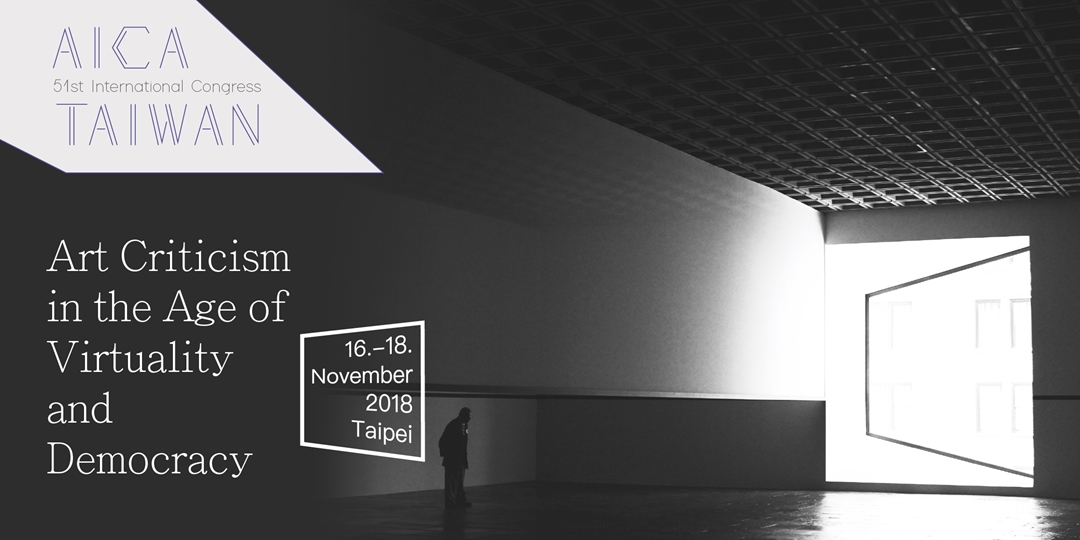
This year's AICA Congress theme is <<Art Criticism in the age of Virtuality and Democracy>>, and it addresses key issues concerning the role of art criticism in an age increasingly defined by technological advancements and turbulent political climates. Over the course of 3 days, we will have 33 speakers from 20 countries present their research on topics related to the Congress theme.
The community, social relations, daily life, the body, and even life itself are entering a large number of virtualization programs. As the human-machine interface continues to progress into today's brain-computer interface, consciousness has become an object that can be directly manipulated; coupled with various breakthroughs in genetic engineering, replicating primates is technically possible. How does art respond to these new conscious and life-engineering possibilities? The virtual network mobilizes time and space, and it reorganizes the values and identities of our daily lives. Has this development led to the simplification of society? And what effect does it have on contemporary art? How will it be measured and interpreted?
In this vision, new relationships have emerged between new technologies and life politics. For example, how will artificial intelligence and big data collection form new governance? Traditional labor is gradually being replaced by machines; over-expanding technology giants with huge amounts of data are beginning to be criticized for being anti-competitive, addictive, and harmful to democracy ( Big, Anti-competitive, Addictive and Destructive to Democracy, BAADD).
The post-truth environment allows the media and messages to form an independent system that in turn affects the whole. The ubiquitous information convergence technology has produced a popular image of hyperreality that is political, social, commercial, and artistic. Although the sense of presence in the work is thin, it also makes the attitude of art intervention in society more pragmatic and transparent. How can an artist translate the pseudo-mime in virtual reality into real space through action or play? After the 21st century, the individualistic "self" and the post-truth environment are exposed in the artist's creation?
On the other hand, democracy is undoubtedly the most widely-accepted system of government today. The democratization and liberation of the nation-state and its society, and thus how to change and even shape its art, is both aesthetic and social. However, with the help of cyberspace and the media, the phenomenon of democratic retreat has brought democracy into a crisis. How do artists intervene through action or play? In the process of democratization, transformational justice has also become the focus. How does art respond? In the transition period, how do we analyze and structure the relationship between art, conflict, and justice? How can art play a positive role in democratic freedom?
Congress Schedule
Nov. 16 (Fri)
Symposium Day 1 @ B1F Auditorium, Taipei Fine Arts Museum
|
Time |
Schedule |
Subject Title |
|
8:30 - 9:20 |
Registration |
|
|
9:20 - 10:00 |
Opening
Ceremony |
|
|
10:00 - 10:45 |
Keynote 1: Audrey Tang (Taiwan) |
Forking Democracy |
|
10:45 - 11:00 |
Break |
|
|
11:00 - 11:45 |
Keynote
2: Nikos Papastergiadis (Australia) (Moderator: Lisbeth Gonçalves)
|
The Matrix of Visibility
and Legitimacy: Art and Democracy in the Age of Digital Participation |
|
11:45 -
12:15 |
Invited
1: Henry Meyric Hughes (UK) (Moderator: Lisbeth Gonçalves) |
Seventy Years of AICA,
reflected through the PRISME Research Project: Some Preliminary Findings from
the Archives in Rennes |
|
12:15 -
14:00 |
Lunch |
|
|
14:00 -
15:20 |
Session
I (Moderator: Pei-Ni Hsieh) |
|
|
1. Liam
Kelly (Ireland) |
The Poetics and Politics of Shane Cullen’s ‘The Agreement’ |
|
|
2.
Richard Read (Australia) |
Trajective Art Criticism: Boats (Trains, Planes) and Home in the Era of retreat from
Democracy |
|
|
3. Rui
Gonçalves Cepeda (UK) |
The Illusion of Art Without Mediation: Challenging the
Challenged Democracy. |
|
|
15:20 -
16:00 |
Afternoon
Tea |
|
|
16:00 -
17:10 |
Session II (Moderator: Tieh-Chih Chang) |
|
|
|
1.
Lisbeth Bonde (Denmark) |
On "Art Criticism in the Age of Virtuality?" |
|
|
2.
Natalie King (Australia) |
Turbulence: How Can Creativity and Art Criticism Respond to
Uncertain and Unsettling Times in the Age of Virtuality? |
|
|
3. Ewa
Wójtowicz (Poland) |
The Post-Internet Way of Art Criticism |
|
17:10
– 17:30 |
End of Symposium Day 1 |
|
Nov. 17 (Sat) Symposium Day 2 @ Sage Hall, MoNTUE, National
Taipei University of Education
Time | Schedule & Subject Title | Venue/Place | |
12:30 -
13:15 | Registration | ||
13:30 -
14:15 | Invited
4 & 5: Chieh-Jen Chen & Chien-Hung Huang (Taiwan) | Notes on the Causes | Sage Hall |
14:15 -
14:30 | Break | ||
14:30 -
15:45 | Session III | ||
A @ Sage Hall | B @ MoNTUE (Moderator: Pei-Yi Lu) | ||
1. Rahma Khazam (France)
- Truth or Post-Truth ? | 1. Discussion with Nicholas
Papastergiadis (Australia) | ||
2. Elisa
Rusca (Italy/ Swiss) - A Brave New Virtual World | 2. Agnieszka Sural (Poland) - No More Professional Writers in the Future? | ||
3. Kang-Jung Chan (Taiwan)
- The Image War of Chiang Kai-shek’s Statues: The State of Exception in the
Process of Promoting Transitional Justice in Taiwan | 3. Lisa Streitfeld (USA) - Unlimited Uncertainty: A Critical Narrative of
Art Self-Powered by the Virtual | ||
15:45 -
16:10 | Afternoon
Tea | ||
16:10 -
17:25 | Session
IV | ||
A @ Sage Hall | B @ MoNTUE | ||
1. Małgorzata Kaźmierczak (Poland) - Politics of Performance
Art Before and After 1989 | 1. Alfredo Cramerotti (UK)-Within
Digital Culture: The Hyperimage Perspective on Art and Criticism | ||
2. Raylin Tsai (Taiwan) - Art as Events with the Virtual: Rethinking
about the Democracy and Bureaucracy | 2.
Bernhard Serexhe (Germany) - Total Control and Censorship:
Towards a New Humanity? | ||
3. Holly Crawford (USA) – Hyperallergic: A Model for Art Criticism and Cultural in the Digital Age | 3. Marilena Preda Sanc (Romania) - Eco-Democracy and Romanian Contemporary Public Art | ||
17:25 - 18:00 | End of Symposium Day 2 | ||
Nov. 18 (Sun) Symposium Day 3 @ Sage Hall, MoNTUE, National
Taipei University of Education
Time | Schedule & Subject Title | Venue/Place | |
9:30 - 10:00 | Registration | ||
10:00 - 10:45 | Keynote 3: Hsin-Chien
Huang (Taiwan) (Moderator: Chih-Yung Chiu) | To the Moon | Sage Hall |
10:45 -
11:00 | Break | ||
11:00 - 11:30 | Invited 6: Bélgica
Rodríguez (Venezuela) (Moderator: Ming-Hui Chen) | On “Art Discourse Facing Challenged Democracy” | |
11:30 - 12:00 | Invited 7: robotlab
(Germany) (Moderator: Ming-Hui Chen) | Exploring Robots | |
12:00 -
13:30 | Lunch | MoNTUE | |
13:30 -
14:45 | Session V | ||
A @ Sage Hall (Moderator: Hung-Chang Lin) | B @ MoNTUE | ||
1. Judith E. Stein and
Jamie Keesling (USA) - AICA-USA Online: Being
Effective, Virtual, and Real in the Twenty-First Century | 1. Damian Smith
(Australia) - Xiao Lu’s Dialogue | ||
2. Yu-Juin Wang (Taiwan) - An Eco-System of Criticism-Activism to Empower “Overcoming the Past” - Film Discourse and <NN 15> Community Project of Taiwan’s White Terror Memory | 2. Jean Bundy (USA) - Arctic
Environmental Challenges through Virtuality | ||
3. Jovanka Popova and Mira Gacina (Macedonia) - Aesthetic of Protest: The Colorful Revolution * Video Presentation | 3. Sabine Grosser (Germany) – Contemporary Art, Democratization and Social Change: Politics of Art in Postcolonial Buddhist Sri Lanka. | ||
14:45 -
15:00 | Break | ||
15:00 -
15:30 | Young Art Critics Winner | A Theater—in Absence | Sage Hall |
15:30 -
16:20 | Closing Ceremony | ||
16:30 -
17:00 | End of Symposium Day 3 | ||